
As the title suggests, A Night To Remember: The Classic Account of The Final Hours of The Titanic tells the story of what happened in the “unsinkable ship's” final hours. The Titanic was the largest and most luxurious ship in the world. Moreover, she had a system of water-tight doors that many people at the time thought made the Titanic practically unsinkable. On April 10, 1912, she left for her maiden voyage to New York City. On April 14, 1912, at 9:30 pm the workers in the crow’s nest are told to watch for ice. At 11:40 pm the same day she collides with an iceberg that was estimated to be 400 feet in length and 100 feet above the water’s surface.
This collision would lead to the estimated deaths of 1,500 people. However, if the ship had started to turn away from the iceberg 30 seconds earlier or later all of this could have been avoided. Instead, a large part of the side of the ship was damaged, allowing water to flood in. If she had hit the iceberg head-on the disaster could have been avoided, but perhaps the most interesting part of this whole story is what was going through the passengers' minds during the three hours between hitting the iceberg and the ship sinking.
At first, the passengers had no idea what was transpiring. Many lay in bed after an extravagant dinner that night. The Titanic boasted finely carved mahogany, grand staircases, and beautifully designed furniture for first-class passengers. It was only when rooms were being flooded that people started gathering on the deck of the ship.

Above is an image of the lavish interior of the Titanic. The image was found here.

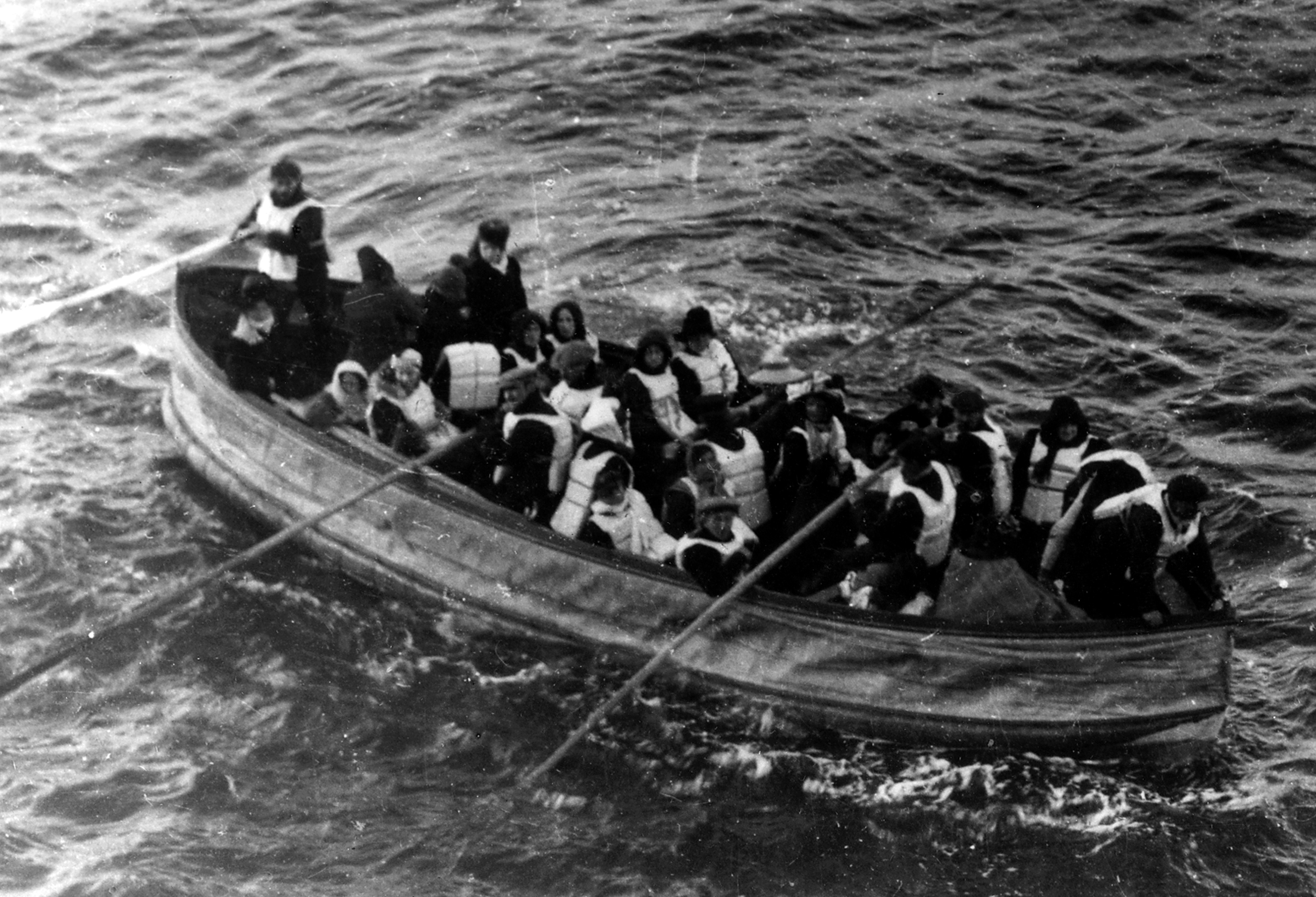
Above is an image of a lifeboat from the Titanic. It was found here.
Even as the ship was taking more and more water in, people remained complacent. At 12:45 a.m. the first lifeboat was launched with 28 people on board out of a capacity of 65. Many people felt safer on the 11-story Titanic than in a tiny boat in the middle of the dark frigid ocean. At that point, people did not feel that they were in danger. In the meantime, the crew of the Titanic was the first to use the new universal call for help, SOS. Unfrontualy, no one would come in time to save all the lives that would be lost on the Titanic.
By the time people felt they were endangered, it was too late. People were so frantic that some jumped 10 feet off of the liner into a lifeboat that was being lowered. At the time there was a strict social code that women and children (under 12) must go first. Despite that, far more men were saved than third-class children. In fact, those in third class were locked below deck, and many were left to drown within the ship. In desperation, some men kidnapped children or dressed up as women to get on the ship. Personally, if I were them I think I would have done the same thing, especially considering many of the lifeboats were sent out half-empty. What do you think you would have done to survive? Would you have sacrificed your life because of social norms, or tried your best to get on a lifeboat?
Another problem that lead to the death of so many people was the inadequate number of lifeboats. There were only 16 boats and four collapsible that could accommodate only 1,178 people, while there were 2, 240 total passengers. Thanks to the tragedy that was the Titanic’s maiden voyage all ships are now required to have as many lifeboats as needed to account for all the ship's passengers.
Despite the bleak circumstances the crew worked valiantly to try and save as many people as possible. At one point they were throwing people into lifeboats that refused to leave the Titanic. Edward John Smith, the Captain of the Titanic went down with the ship. It was going to be his last voyage before he peacefully retired, but instead, he spent his last hours helping others escape.

Above is an image of Edward John Smith, the Captain of the Titanic. This image can be found here.
Those who managed to make it onto a lifeboat or hold on to a piece of driftwood long enough were picked up by a ship called the Carpathia. While, the last survivor of the Titanic Millvina Dean, who was just two months old at the time of the tragedy, died in 2009 at the age of 97 it is important to remember that if it were not for the Titanic ship regulation and safety would not be where it is today. Ships are now required to have enough lifeboats for everyone on board, are designed so it is harder for water to get in, and the routes ships take are not as far north as they used to be to avoid icebergs. In the end, the story of the Titanic serves as a cautionary tale for all ships that voyage today. If anything the Titanic showcases the dangers of classism, gender norms, and overconfidence in a ship.
Thanks for reading!
-Sasha G.
Hey Sasha, I heard about the tale of the Titanic but I never realized the effects that came from it. It was very fascinating to hear how we have all these safety rules and guidelines for ships all because of one incident that took 1,500 lives. A question I have though is who was the person that wrote this book? Were they one of the survivors of the Titanic or was it a historian that researched sources about the Titanic that led to the information in this book?
ReplyDeleteHi Adrian,
DeleteWalter Lord, the author of the book was a Harvard historian. The book is a minute by minute account of the sinking of the Titanic and is based on interviews and intensive research. He was never on the Titanic himself though.
Thanks for reading,
Sasha
Great review, Sasha! Before reading this article, I didn't really know much about the Titanic other than the premise of the movie, so I learned a lot from your article! Also, I'm curious how the author managed to get information on what the passengers were thinking in the hours prior to the ship sinking, and if they maybe found diaries that survived or if its more speculative.
ReplyDeleteHi Chloe,
DeleteThe titanic sunk in 1912 and the book was published in 1955. Walter Lord (the author of the book) was able to interview survivors and look at records of interviews to write his book.
Thanks for reading,
Sasha
Awesome review, Sasha! I learned a lot about the titanic from your article. It was very interesting. Great job!
ReplyDeleteGreat review Sasha! This is a very informative article and full of detail. This is quite fascinating.
ReplyDeleteHi Sasha! I've always been interested in the Titanic and this post was really informative. This book sounds really interesting. Great blog post!
ReplyDeleteHi Sasha, I have always been curious about the Titanic growing up. Although what happened was a tragedy, we were able to learn a lot from the mistakes made (like there not being enough lifeboats). Without this event, it most likely would have been a long time before these safety advancements were made, so a lot of lives were probably saved because of the sinking of the Titanic. Good review!
ReplyDelete